
The Physics Department at University of Chicago was established in 1893 by A. A. Michelson. Michelson was a trailblazing physicist who greatly advanced the field.
This department boasts a storied past, marked by the achievements of Nobel laureates. It is celebrated for its groundbreaking research, solidifying its status as a leading physics institution globally.

Spanning over a century, the Physics Department remains a beacon of innovation. It offers a range of academic programs and research opportunities. These initiatives are instrumental in shaping the future of physics.
Key Takeaways
- The University of Chicago Physics Department was founded in 1893.
- The department has a history of producing Nobel laureates.
- It is known for conducting cutting-edge research.
- The department offers various academic programs.
- It provides research opportunities for students and faculty.
The Legacy and Reputation of UChicago Physics
The University of Chicago Physics Department boasts a storied past of innovation and excellence. For decades, it has served as a beacon for groundbreaking research. It has also been the cradle for some of the most influential physicists of our era.
Historical Breakthroughs and Nobel Laureates
The department’s legacy is adorned with significant milestones. Notably, Robert Millikan’s oil-drop experiment measured the electron’s charge. Subrahmanyan Chandrasekhar’s work on stellar evolution, including black holes, also stands out. These achievements have earned global acclaim, with several faculty and alumni receiving the Nobel Prize. The uchicago physics faculty has been instrumental in expanding our knowledge of the physical universe.
Current Standing in the Global Physics Community
In the present day, the University of Chicago Physics Department holds a premier position in the global physics arena. It is celebrated for its research in uchicago physics dept, covering a broad spectrum from theoretical to experimental physics. The department’s dedication to academic rigor and innovative research draws elite scholars from across the globe.
Understanding the University of Chicago Physics Dept. Structure
To grasp the University of Chicago Physics Department, one must explore its complex structure. It houses numerous research institutes and centers, such as the Enrico Fermi Institute and the James Franck Institute. These entities are key in pushing the boundaries of physics research.
Organizational Framework and Leadership
The department is guided by a chair and a robust administrative team. They oversee academic programs at UChicago Physics Dept. This leadership is essential in steering the department’s research and educational efforts. The structure is crafted to promote collaboration among faculty and students, boosting the research atmosphere.
| Leadership Role | Responsibility |
| Department Chair | Oversees departmental operations and research directions |
| Research Institute Directors | Manage specific research institutes like the Enrico Fermi Institute |
Interdisciplinary Connections Across Campus
The Physics Department at the University of Chicago is deeply connected with other departments. This includes the Astronomy & Astrophysics Department and the Chemistry Department. These connections enhance the physics degree options at UChicago, providing a broad educational experience.
By merging insights from diverse fields, the department creates a fertile ground for groundbreaking research and academic achievement.
How to Navigate Undergraduate Programs and Opportunities
The University of Chicago Physics Department offers a wide range of undergraduate programs. These programs aim to enhance academic excellence. They focus on both theoretical foundations and practical applications, creating a rich academic environment for students.
Bachelor’s Degree Options and Specializations
The department provides a Bachelor of Science in Physics, with various specializations. Students can explore astrophysics, condensed matter physics, and high-energy physics, among others. This allows students to customize their degree to fit their interests and career aspirations.
Undergraduate Research Opportunities
Undergraduate research is a key part of the Physics Department’s offerings. Students can participate in cutting-edge research projects led by esteemed faculty. This hands-on experience is essential for those interested in physics or related fields.
Student Organizations and Physics Clubs
The department also supports student organizations and physics clubs. These groups offer a community for physics enthusiasts. They host seminars, workshops, and social events, providing a space for networking and deepening physics knowledge.
Exploring these undergraduate programs and opportunities allows students to maximize their time at the University of Chicago Physics Department. It prepares them for success in their future careers.
Steps to Explore Graduate Studies in Physics at UChicago
The University of Chicago Physics Department provides a graduate program aimed at academic excellence and innovative research. Students can pursue a Master’s or PhD, both built on a solid theoretical and experimental physics foundation.
Master’s and PhD Program Structure
The graduate program in physics at UChicago is designed to deeply understand physics principles. It prepares students for original research. The Master’s program includes coursework and a research project. The PhD program focuses on original research, ending in a dissertation.
- Coursework in advanced physics topics
- Research opportunities with faculty members
- Development of teaching skills through assistantships
Research Requirements and Dissertation Process
Graduate students at UChicago are expected to conduct original research under faculty guidance. The PhD dissertation process involves several steps. These include selecting a research topic, completing the research, and defending the dissertation before a faculty committee.
Key aspects of the research and dissertation process include:
- Identifying a research topic in collaboration with a faculty advisor
- Conducting original research that contributes to the field of physics
- Preparing and defending a dissertation
Funding Opportunities and Teaching Assistantships
The University of Chicago Physics Department offers funding to support graduate students. This includes teaching assistantships and research grants. These opportunities provide financial support and valuable experience in teaching and research.

How to Apply to the University of Chicago Physics Dept.
Applying to the University of Chicago Physics Department is a competitive endeavor. It demands meticulous preparation. Prospective students must grasp the specific criteria for both undergraduate and graduate programs.
Undergraduate Application Process
The undergraduate application process entails several critical steps. Applicants must submit essential documents, such as transcripts and test scores. They also need to fulfill physics-specific requirements.
Required Documents and Deadlines
Students must provide their high school transcripts, SAT or ACT scores, and letters of recommendation. The application deadline is usually in January for the next fall quarter.
Physics-Specific Requirements
A robust background in physics and mathematics is vital. Applicants are expected to have taken advanced courses in physics and calculus.
Graduate Admissions Criteria and Timeline
For graduate admissions, applicants must hold a bachelor’s degree in physics or a related field. The admissions committee assesses applicants based on their research experience, academic performance, and letters of recommendation.
| Application Component | Deadline | Requirements |
| Transcripts | December 15 | Official transcripts from all previous institutions |
| Letters of Recommendation | December 15 | At least 3 letters from academic or professional references |
| Personal Statement | December 15 | A statement outlining research interests and goals |
Tips for Creating a Competitive Application
To make your application stand out, emphasize your research experience and academic achievements. A well-crafted personal statement is essential. It allows applicants to express their interests and goals.
Guide to Discovering Research Areas at the University of Chicago Physics Dept.
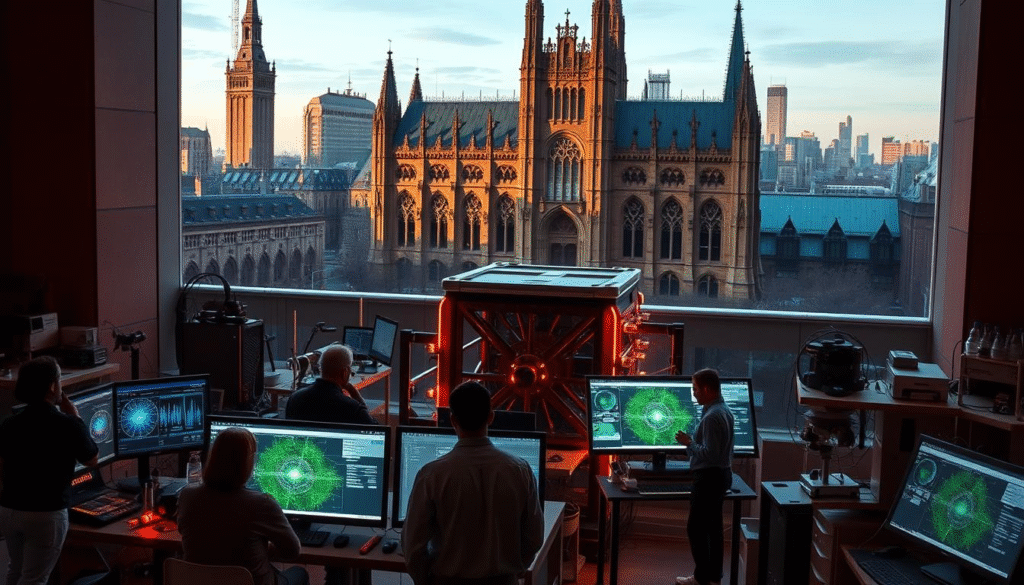
The University of Chicago Physics Department is a hotbed of innovation, covering everything from theoretical physics to experimental projects. It’s a place where students and faculty can dive into a multitude of research opportunities. This environment is perfect for those eager to explore the frontiers of physics.
Theoretical Physics Research Groups
Theoretical physics groups at the University of Chicago are pushing the boundaries of our understanding of the universe. They focus on quantum mechanics and field theory. Here, faculty and students collaborate on projects that aim to uncover the fundamental laws of nature.
Experimental Physics Initiatives
Experimental physics at the University of Chicago is all about cutting-edge technologies. It’s where researchers explore new territories in physics. From high-energy particle physics to condensed matter physics, the department leads the way in experimental research.
Astrophysics and Cosmology Studies
Astrophysics and cosmology studies at the University of Chicago are dedicated to unraveling the universe’s mysteries. They focus on dark matter and dark energy. Researchers combine theoretical models with observational data to shed light on cosmic phenomena.
Quantum Information Science
Quantum information science is a rapidly advancing field that leverages quantum mechanics for information processing and transmission. The University of Chicago is at the forefront of this field. Researchers here are exploring quantum computing and quantum cryptography.
| Research Area | Focus |
| Theoretical Physics | Advancing understanding through quantum mechanics and field theory |
| Experimental Physics | Exploring new frontiers with cutting-edge technologies |
| Astrophysics and Cosmology | Understanding dark matter, dark energy, and cosmic phenomena |
| Quantum Information Science | Harnessing quantum mechanics for information processing |
“The University of Chicago Physics Department is a vibrant community that fosters innovation and collaboration across various research areas.”
— Physics Department Overview
How to Connect with Renowned Faculty
Students at the University of Chicago Physics Department have a unique chance to interact with leading physicists. The department boasts faculty members, including Nobel laureates, who are redefining physics. Their work is shaping the future of the field.
Prominent Professors and Their Specialties
The University of Chicago Physics Department houses faculty with diverse specialties. Professors are engaged in groundbreaking research across theoretical, experimental, astrophysics, and quantum information science. Students can explore these fields and find mentors who share their interests.
Strategies for Approaching Potencial Mentors
To connect with renowned faculty, students should first identify mentors whose research matches their interests. Attending department seminars and workshops is a great way to meet faculty and learn about their work. Students can then reach out to these professors to discuss research opportunities or seek guidance.
Participating in Faculty Office Hours and Research Groups
Another effective way to connect with faculty is by participating in their office hours and research groups. Office hours provide a chance for one-on-one interaction, allowing students to discuss their research interests and receive personalized advice. Joining research groups enables students to collaborate with faculty and peers on projects. This fosters a deeper understanding of physics and develops research skills.
Step-by-Step Guide to Touring Facilities and Laboratories
Prospective students can dive deep into the University of Chicago Physics Department’s research capabilities by touring its facilities. The department boasts state-of-the-art facilities and laboratories. The Eckhardt Research Center, for instance, offers students hands-on experience with cutting-edge equipment.
Scheduling Official Department Tours
To schedule an official tour, prospective students should contact the department’s administrative office. These tours offer a detailed look at the department’s facilities. This includes research laboratories and collaborative workspaces. By attending a tour, prospective students can see the department’s resources firsthand.
Exploring the Eckhardt Research Center
The Eckhardt Research Center is a key hub for physics research at the University of Chicago. It’s equipped with the latest equipment, giving researchers the tools to push the boundaries of our understanding of the physical world. Visitors can explore the center’s facilities during an official department tour.
Accessing Specialized Research Laboratories
Beyond the Eckhardt Research Center, the University of Chicago Physics Department has a variety of specialized research laboratories. These labs are equipped with advanced equipment, enabling researchers to conduct experiments and gather data. Prospective students can learn more about these laboratories during their tour or by reaching out to department faculty.
How to Participate in Physics Events and Seminars
The University of Chicago’s physics department is dedicated to creating a dynamic academic space. It hosts various events and seminars. These opportunities allow students to connect with the physics community, stay updated on new research, and build relationships with peers and faculty.
Finding and Registering for Annual Conferences
The department organizes annual conferences that attract physicists globally. Students can check the department’s website for information on upcoming conferences. They will find details on registration and abstract submission guidelines. Registration typically opens several months before the conference date, so students are advised to submit their abstracts early to secure a spot.
Attending Weekly Colloquia and Speaker Series
Weekly colloquia and speaker series are a key part of the department’s schedule. These events feature renowned physicists discussing their latest research. Students are encouraged to attend to expand their knowledge and interact with the speakers. Details about upcoming colloquia are usually circulated via email and posted on the department’s website.
Engaging in Public Outreach and Community Events
The department also engages in public outreach and community events. These efforts aim to share the excitement of physics with a wider audience. Students can participate in these activities, contributing to science education and community engagement. Opportunities for participation are often announced through the department’s newsletter and social media channels.
Conclusion: Why Choose the University of Chicago Physics Dept.
The University of Chicago Physics Department is a shining example of academic excellence. It boasts a strong reputation for research and academic rigor. This provides students with a well-rounded education in physics.
The department’s dedication to cutting-edge research is clear through its interdisciplinary approaches and innovative methodologies. Students get to work with renowned faculty. They also participate in groundbreaking research projects.

The University of Chicago Physics Department’s strengths can be summarized in the following table:
| Aspect | Description | Benefit |
| Research Opportunities | Engage in cutting-edge research projects | Gain hands-on experience in physics research |
| Faculty Expertise | Learn from renowned professors | Benefit from their expertise and mentorship |
| Academic Programs | Rigorous undergraduate and graduate programs | Comprehensive education in physics |
In conclusion, the University of Chicago Physics Department is a top choice for physics education. It offers a rich academic environment and unmatched research opportunities. Its strong reputation and commitment to excellence make it perfect for those aiming for a physics career.
Sources
To learn more about the University of Chicago Physics Dept, visit the official University of Chicago Physics Department website. The UChicago Graduate Programs Catalog offers detailed insights into graduate studies.
The physics department at the University of Chicago is renowned worldwide for its research prowess. Explore their research initiatives and faculty profiles through these sources:
- University of Chicago Physics Department Official Website
- American Physical Society – University Rankings and Department Profiles
- National Science Foundation – Research Funding at UChicago Physics
These resources offer a detailed look at the University of Chicago Physics Dept’s academic offerings, research fields, and faculty expertise.
FAQ
What are the research areas available at the University of Chicago Physics Department?
The University of Chicago Physics Department is a leading center for research. It covers a wide range of areas, from theoretical and experimental physics to astrophysics and cosmology. Quantum information science is also a key focus.
What kind of academic programs does the University of Chicago Physics Department offer?
The department provides a variety of academic programs. These include undergraduate and graduate degrees in Physics. Options include a Bachelor of Science, Master’s, and PhD, with specializations and research opportunities available.
How can I connect with faculty members at the University of Chicago Physics Department?
Connecting with faculty is easy through research projects, office hours, and research groups. This allows students to dive deep into physics and hone their research skills.
What kind of facilities and laboratories are available at the University of Chicago Physics Department?
The department boasts a variety of facilities and laboratories. The Eckhardt Research Center is one example. It gives students hands-on experience with advanced equipment and facilities.
How can I apply to the University of Chicago Physics Department?
Applying to the department is competitive. It requires a strong application, including transcripts, test scores, and a research background. This is true for both undergraduate and graduate applicants.
What kind of events and seminars does the University of Chicago Physics Department host?
The department hosts various events and seminars. These include annual conferences, weekly colloquia, and public outreach events. They offer chances for networking and learning.
What is the legacy and reputation of the University of Chicago Physics Department?
The department has a rich legacy, marked by historical breakthroughs and Nobel laureates. It is a top institution globally, known for its research and academic excellence.
Are there any opportunities for undergraduate research at the University of Chicago Physics Department?
Yes, the department offers many research opportunities for undergraduates. Students can work with faculty on projects, gaining practical experience in physics research.
What kind of funding opportunities are available for graduate students at the University of Chicago Physics Department?
Graduate students have access to various funding options. These include teaching assistantships, which support their research and studies.